FraudShield Project Description
Content for partner university websites
| FraudShield: Empowering Adults Against Financial Scams and Social Engineering in the Age of AI |
Financial fraud is becoming increasingly sophisticated. Scammers use artificial intelligence, digital communication channels, and social engineering techniques to imitate trusted people and institutions, manipulate decisions, and obtain money or personal information.
Adults need more than general warnings about fraud. They need practical skills and learning opportunities that reflect their individual financial vulnerabilities and gaps in knowledge.
FraudShield is an Erasmus+ Cooperation Partnership in Adult Education that aims to strengthen adults’ ability to recognise, verify, and resist financial scams and social engineering. The project will combine financial vulnerability assessment, case-based testing, personalised learning, and community support.
Although FraudShield uses validated assessment tools and evidence-based methods, its primary purpose is educational: to translate identified vulnerabilities and knowledge gaps into accessible and practical learning opportunities for adults.
Project at a glance
| Project information | |
| Full title | FraudShield: Empowering Adults Against Financial Scams and Social Engineering in the Age of AI |
| Project acronym | FraudShield |
| Programme | Erasmus+ |
| Action | KA220-ADU – Cooperation Partnerships in Adult Education |
| Project number | 2026-1-CZ01-KA220-ADU-000465130 |
| Duration | 1 November 2026 – 31 October 2028 |
| EU grant | EUR 400,000 |
| Coordinator | Mendel University in Brno, Czechia |
| Partnership |
FraudShield brings together seven organisations from five countries:
The Deposit Guarantee Fund of Ukraine contributes to the project as an associated partner. |
Project objectives
|
Target groups
|
FraudShield is designed for adults of different ages and backgrounds, with particular attention to:
|
Main activities and expected results
|
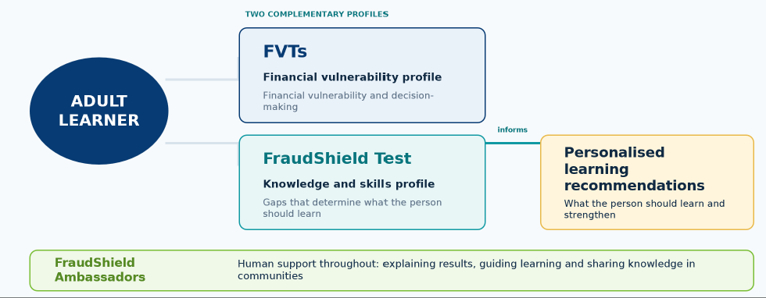
Financial Vulnerability Assessment Tools The project will adapt and validate two assessment tools developed by Professor Peter A. Lichtenberg and his colleagues: the Financial Exploitation Vulnerability Scale (FEVS) and the Lichtenberg Financial Decision Rating Scale (LFDRS). Project`s Financial Vulnerability Tests (FVTs) include FEVS and LFDRS. These tools will help identify vulnerability to financial exploitation and assess challenges related to making specific financial decisions. Both tools will be adapted and validated in five languages. At least 1,500 participants across the partner countries will participate in testing. |
|
FraudShield Test The consortium will develop a case-based FraudShield Test containing at least 25 realistic fraud scenarios. It will assess the knowledge and practical skills adults need to recognise suspicious situations, verify information and respond safely. |
|
Personalised learning The assessment results will inform personalised learning recommendations, helping each participant understand which areas they should strengthen. The project will develop:
|
|
FraudShield Platform A multilingual digital platform will provide access to the assessment tools, personalised learning recommendations, micro-courses and practical learning materials. The platform will bring assessment and education together in one accessible environment. |
|
FraudShield Ambassadors At least 30 FraudShield Ambassadors will be trained and certified. They will support adult learners, provide guidance, and help share knowledge about financial fraud within local communities. The project will also develop a practical toolkit to support their work. |
|
Training dissemination and policy recommendations At least 300 adults will participate directly in FraudShield training activities. Local workshops, international events, and online communication will help disseminate the project’s results. The consortium will also prepare open-access publications and a Policy Brief with recommendations for adult education, financial consumer protection, and public policy. |
Follow FraudShield
Follow the project’s activities, learning resources, and events on social media:
EU funding acknowledgment
|
Funded by the European Union. Views and opinions expressed are however those of the author(s) only and do not necessarily reflect those of the European Union or the European Education and Culture Executive Agency (EACEA). Neither the European Union nor EACEA can be held responsible for them. |